Luxury Watch Blog & Guides
Selling Patek Philippe in UAE: 2026 Resale Reality
Selling Patek Philippe in 2026 is harder in the UAE because buyers are more selective, overlisted watches sit longer, and only the right references still move quickly. Nautilus, Aquanaut, rare complications, discontinued pieces, and clean full-set watches can still attract demand, but weaker-condition dress models, missing-paper examples, and unrealistic asking prices face more resistance. This guide is for Dubai and UAE owners who want to price a Patek Philippe properly, understand resale pressure, and know what to check before offering their watch to the market.
Selling Patek Philippe in UAE: What Matters First?
Selling Patek Philippe in 2026 is less about brand name alone and more about reference strength, condition, documentation, price realism, and buyer demand in the UAE market. Nautilus, Aquanaut, rare complications, discontinued references, and clean full-set watches usually attract stronger attention, while overlisted pieces, weak-condition dress models, missing-paper examples, and unrealistic asking prices can take longer to move.
In the landscape of high-end horology as of late 2025, the process of Selling Patek Philippe has shifted dramatically from the relative ease of acquisition hurdles faced by buyers. Production caps at 72,000 units annually, up from 62,000 in 2022, create a controlled scarcity that inflates demand but complicates resale for owners holding pieces purchased during peak tariff periods. With 58,000 automatic movements and only 7,000 quartz variants predominantly in the Twenty~4 line, sellers must navigate a market where 16.5 million components underpin each watch’s value, yet economic tariffs erode profit margins.
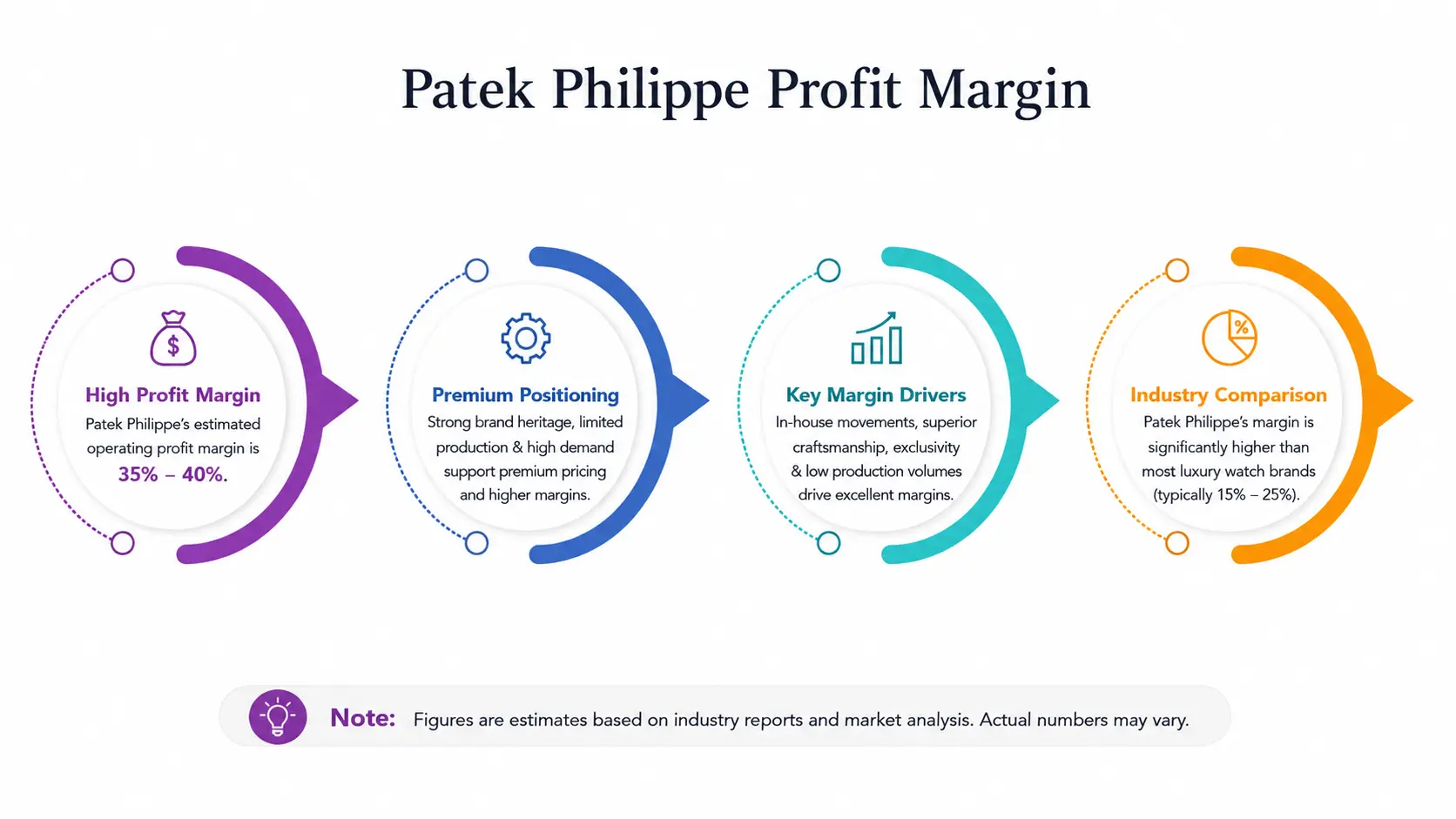
Patek Philippe Profit Margin
Patek Philippe’s exact profit margin is not publicly disclosed, because the company is privately owned. However, luxury-watch industry estimates suggest Patek Philippe operates with strong margins due to limited production, high brand equity, controlled distribution, and very high demand. Recent estimates place its annual revenue around CHF 2 billion to CHF 2.5 billion, but official net profit figures are not available.
- Official margin: Not publicly reported
- Estimated operating margin: Often assumed to be high, but not confirmed
- Main reason for strong profitability: Limited supply + premium pricing
- Retail margin: Authorized dealers may have separate margins, usually lower than brand-level margin
- Secondary market profit: Depends heavily on model, condition, rarity, and purchase price
- Best margin models: Nautilus, Aquanaut, rare complications, discontinued references
- Risk: Not every Patek Philippe sells above retail; profit is model-specific and market-dependent
Historical Buying Barriers
Buyers have long contended with waitlists extending 5-8 years for models like the Nautilus, where authorized dealers prioritize clients with purchase histories exceeding $100,000 in less desirable pieces. In 2025, this barrier persists, with 254 qualified watchmakers at Patek’s Geneva facilities producing just 15 base calibers for wristwatches, leading to allocation strategies that favor repeat purchasers over newcomers.
The blacklist system, triggered by service records on flipped watches, further deters quick resales, making initial acquisition a gated entry that ironically simplifies buying compared to the multifaceted challenges in Selling Patek Philippe today.
Selling Patek Philippe Is Getting Harder Than Buying
A compact 2025 snapshot comparing demand, production dynamics, and market friction in the secondary market for Patek Philippe watches. Understanding these numbers helps collectors decide when to buy or sell with better timing.
Controlled production remains the main structural factor behind limited supply and market liquidity pressure.
Output growth since 2022 slightly increases market availability and can soften extreme premiums.
Most demand centers around automatic movements with full documentation and verified provenance.
Import duties and taxation influence pricing spreads across global secondary markets.
Long boutique waitlists restrict primary supply, pushing buyers toward the secondary market.
Short-term price growth can continue even during periods of reduced liquidity.
Private deals decline when buyers demand full sets, receipts, and traceable ownership history.
High-value dial or component fraud can erase profits, making authentication essential.
Emerging Resale Obstacles
Resale obstacles in 2025 stem from a +1.5% monthly price growth for Patek Philippe, contrasting with declines in competitors like Audemars Piguet. Sellers face authentication scrutiny, where even verified pieces like the 5711/1A Tiffany can plummet from $1.5 million to below cost due to counterfeit dials undetected initially by Patek’s own experts. Market data shows quarterly gains in pre-owned values for the first time in three years, yet liquidity drops as buyers demand original receipts, reducing viable Selling Patek Philippe opportunities by 20-30% in private transactions.
Pricing Structures Analyzed
Pricing for Patek Philippe in 2025 reveals stark disparities, with average watches at $48,000 but ranging up to $806,000 for grand complications. Selling Patek Philippe now requires accounting for a 39% tariff impact, pushing secondary averages 41-214% above retail for select models, yet overall market indices like the Patek 25 show stabilization after a 2.7% six-month rise.
Retail Escalations Due to Tariffs
The September 15, 2025, 15% U.S. retail hike, driven by a 39% tariff on Swiss imports, affected flagship models directly. The Nautilus 5811 jumped from $74,000 to $85,000, while the Aquanaut 5167A rose to $28,000 from mid-$20,000s. This escalation, absorbing only part of the tariff, signals Patek’s strategy to maintain prestige, but it narrows resale premiums, making Selling Patek Philippe less profitable for holders of pre-hike inventory. Info: Tariffs effective August 7, 2025, have led to a projected 10-35% secondary price surge over six months for steel sports references
Selling Patek Philippe Price Reality Check
Retail vs secondary vs auction highs. Use this snapshot to understand how different Patek Philippe references perform when buying or selling on the secondary market.
| Model | Retail (USD) | Secondary Avg (USD) | Appreciation | Auction High (USD) |
|---|---|---|---|---|
| Nautilus 5711 | $35,000 | $110,000 |
+214%
|
$300,000 |
| Aquanaut 5167 | $25,000 | $60,000 |
+140%
|
$75,000 |
| Complications 5270 | $85,000 | $120,000 |
+41%
|
$150,000 |
| World Time 5230 | $55,000 | $70,000 |
+27%
|
$90,000 |
| Calatrava 6119 | $41,000 | $25,000 |
−39%
|
$35,000 |
Secondary Market Fluctuations
Secondary fluctuations in 2025 highlight Nautilus resale at $110,000-300,000, often 10-15% higher with box and papers. Complications like the 5270 trade at $120,000 against $85,000 retail, showing 41% appreciation, but unsold auction rates remain low at 5-7% due to longer holding periods. Selling Patek Philippe in this environment demands timing, as July’s +1.5% growth contrasts with broader market steadiness, where pre-owned gains mark the first positive quarter in three years.
Optimized Selling Strategies
Strategies for Selling Patek Philippe involve timing auctions post-Watches & Wonders, where 2025 predictions favor complications over sports. Leverage platforms like Chrono24 for 39 million USD record sales, but insist on escrow for transactions above $50,000 to counter fraud. Focus on unpolished conditions, adding 10% value, and avoid bussdown modifications that devalue by 70%.
Case studies include a Platinum Travel Time sold at 50% off $285,000 list, undercutting dealer costs by 14%. Another, a 5170 chronograph trading below original retail, exemplifies value buys, while a $1.4 million CHF 1563 split-seconds at Phillips underscores rare highs. Selling Patek Philippe in these yielded 15-20% margins for informed sellers, but losses for those ignoring authentication. In the core of this discussion, navigating Patek Philippe watches for sale demands scrutiny of these pressures to avoid losses.
Authentication Protocols
Authentication for Patek Philippe involves rigorous checks, yet 2025 cases reveal pitfalls, such as the $1 million loss on a fake Tiffany dial 5711 despite initial Patek approval. Protocols mandate service records and component verification across 230 average parts per caliber, but drilled cases for diamonds void warranties, complicating Selling Patek Philippe as movements valued at $30,000 could be swapped with $7,000 fakes. Tip: Always secure written verification from Patek before transactions to mitigate risks in a market flooded with China-sourced replicas using real 18k gold.
Dealer Networks and Blacklists
Dealer networks enforce blacklists via service tracking, where flipping a Nautilus within two years bars future purchases, impacting 15-20% of collectors annually. In 2025, with 2,670 employees managing 400 machines, Patek prioritizes salons for allocations, forcing sellers into gray markets where premiums drop 5-10% without dealer backing. Selling Patek Philippe through networks requires building histories, as one LA collector’s acquisition of complications below list highlights relational advantages.
How Tariffs Change Selling Patek Philippe
Use the slider to model how tariff pressure can compress margins. This helps explain why selling Patek Philippe in 2025 can feel more difficult than buying, even when headline prices still appear firm.
Production Volumes Revealed
Patek’s 2025 production hits 72,000 watches, with 50 movement references from 18 base calibers, emphasizing manual winds at 7,000 units. Scarcity is engineered, as 10% quartz output limits feminine lines, while 16.5 million components ensure quality but constrain supply, elevating resale difficulties. This controlled growth, up 4,000 from 2022, sustains waitlists but floods secondary channels with overhyped pieces, making Selling Patek Philippe a precision game
Model-Specific Valuation Data
Valuations vary by model, with entry-level Twenty~4 at $16,260 retail but $12,000-19,000 secondary, often below list. Grand complications like the 5308G-001 feature patented split-seconds innovations, priced implicitly high, yet resale hovers at 20-30% premiums due to collector holding.
Nautilus metrics in 2025 show 5811 at $85,000 retail but over double secondary, with unpolished cases adding 10-15% value. Auction data from Phillips indicates steel refs like 1518 fetching $17.6 million, but average resales dip 5% post-tariff. Selling Patek Philippe Nautilus demands provenance, as fakes proliferate, reducing liquidity by 15%.
Economic Pressures on Sellers
Economic pressures include a 39% tariff squeezing margins, with U.S. sales spiking pre-hike but post-September slumping 10% in volume. Global indices show Patek leading gains at +2.7% over six months, yet sellers face counterparty risks in a downswing market where holidays cool collectibles. Selling Patek Philippe amid this requires hedging against 5-15% buy-sell spreads in precious metals analogs.
Regulatory hurdles encompass counterfeit markets rising 20% with demand, where Selling Patek Philippe without CITES compliance for exotic straps incurs fines up to $10,000. Auction houses like Christie’s report 48,066 lots sold, but unsold rates hit 8% for unverified pieces, mandating provenance under Swiss export laws. Tip: Engage certified appraisers to comply with U.S. tariff declarations, averting 15% penalties.
ALSO READ: Why Audemars Piguet Prices React Faster Than Rolex? Specialist Recommendations
Specialists recommend focusing on Quadruple Complication 5308G with its anti-backlash clutch, valued at premiums due to patents. For Selling Patek Philippe, consult 254 watchmakers’ networks for valuations, and hold pieces like the 5328G for its 8-day reserve, projecting 20% uplift by 2027. Avoid hype; opt for underpriced refs like 5170, trading 15% below retail for savvy resael.
Selling Patek Philippe in UAE FAQ
1. Why is selling Patek Philippe harder in 2026?
2. Which Patek Philippe models are easier to sell in the UAE?
3. How should I price my Patek Philippe before selling?
4. What should I check before selling Patek Philippe in Dubai?

We are the Behzadi Boutique Team, a group of luxury watch specialists and dedicated writers focused on the world of fine timepieces. At Behzadi Boutique, we create clear, practical, and market-aware watch content to help collectors, buyers, and sellers make more confident decisions in the luxury watch market.