Luxury Watch Blog & Guides
How to Spot a Fake Rolex Watch
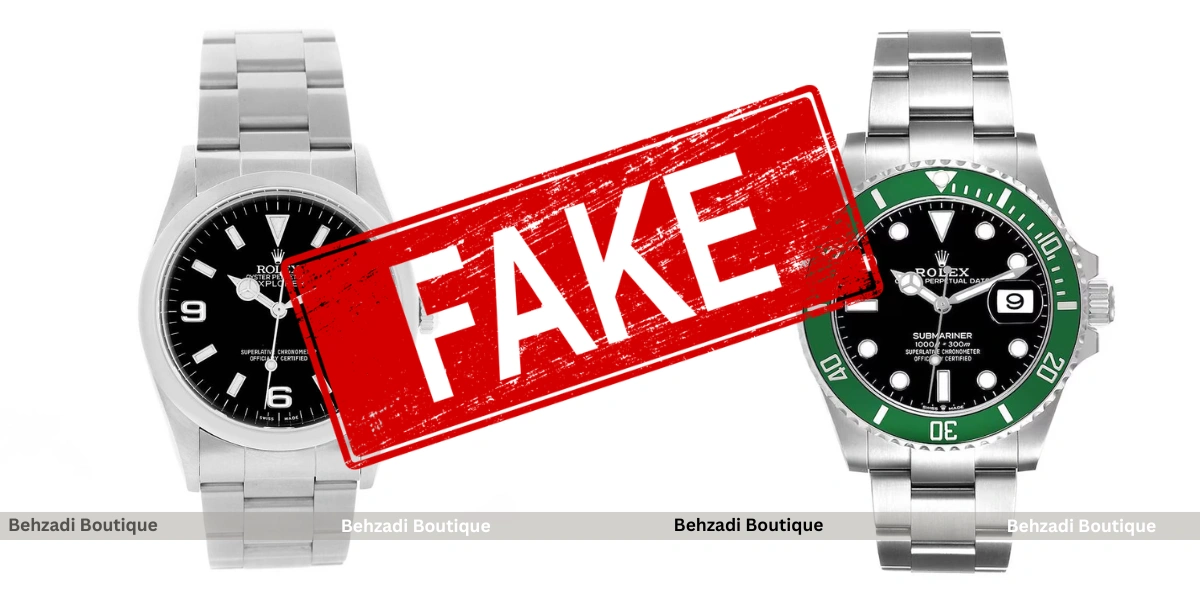
Luxury watches attract attention for many reasons. Craftsmanship, heritage, engineering, and sometimes the quiet satisfaction of wearing something built to last for decades. Among these watches, Rolex sits in a unique position. It is one of the most recognized names in horology, which unfortunately means it is also one of the most frequently copied.
Counterfeit watches exist at every level. Some are obvious imitations that fall apart the moment you look closely. Others are more convincing and try to replicate the small details that make Rolex watches so distinctive. That is where many buyers become unsure. At first glance everything might look correct. The dial says Rolex. The case looks familiar. The bracelet feels similar.
But when you slow down and examine the watch carefully, small differences begin to appear.
Let’s walk through the things that actually reveal the truth.
The Weight and Overall Feel
A genuine Rolex usually reveals itself the moment you hold it. Not because it is dramatically heavy, but because it feels solid and balanced.
Rolex cases are milled from dense blocks of steel, gold, or platinum. The bracelet links are precisely machined. When you pick up the watch, everything feels compact and refined. There is no looseness. No rattling.
Now imagine holding two watches side by side. One feels tight and precise, the other slightly hollow. The bracelet moves but produces a faint metallic sound. That difference often tells you more than any visual inspection.
It is not a rule that solves everything, but it is often the first hint.
Datejust
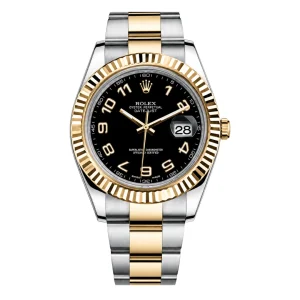
Rolex Datejust 178273 yellow gold steel 31 mm
55,000
Datejust
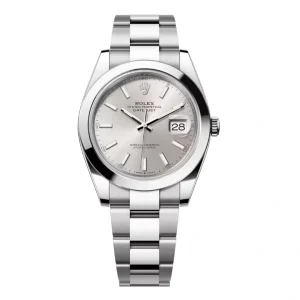
Rolex Datejust 41 116334 Silver Dial 41mm
66,000
Datejust
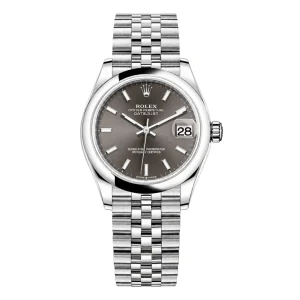
Rolex Datejust 278274 Jubilee steel 31 mm
48,500
Datejust
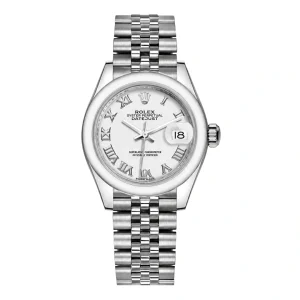
Rolex Datejust 126234-0020 Mother of Pearl Diamond Dial 36mm
60,000
How to Spot a Fake Rolex Watch
A counterfeit Rolex usually gives itself away through small details. The weight, the dial printing, the Cyclops lens, the bracelet feel, and the movement all tell part of the story. Click each point below to explore what actually matters.
Weight & Feel
Solid construction, tight bracelet movement, and a refined presence in the hand.
Dial Details
Clean print, crisp lettering, and perfectly placed hour markers matter more than people think.
Cyclops Lens
The date should appear clearly magnified, not weak, flat, or oddly positioned.
Movement Sweep
A sharp one-second tick is usually the fastest way to spot something suspicious.
Caseback Check
Plain and purposeful is normal. Overdesigned is often not.
Bracelet Quality
Real quality shows up in the clasp action, polished edges, and overall fit.
The Dial Tells the Real Story
If there is one area where counterfeit watches struggle the most, it is the dial.
Rolex dials are produced with extreme precision. The text is perfectly printed. The spacing between letters is consistent. The surface finishing reflects light evenly.
Look closely at the brand name, the model text, and the minute markers around the outer edge of the dial. On a real Rolex these elements appear incredibly sharp.
On many counterfeit watches, small imperfections begin to show when you examine them carefully. The printing may look slightly thick or uneven. Some letters might appear softer at the edges.
The applied hour markers are another important clue. On genuine pieces they sit perfectly aligned and reflect light cleanly. If one marker looks tilted or poorly finished, something is not right.
The Cyclops Lens Over the Date
Rolex introduced the Cyclops lens decades ago, and it has become one of the brand’s most recognizable features.
This tiny magnifying lens sits above the date window and enlarges the number beneath it. On authentic Rolex watches the magnification is strong, roughly two and a half times larger than the original date.
In practical terms that means the date appears large and extremely easy to read.
Many counterfeit watches fail to reproduce this detail correctly. The magnification might look weak or slightly distorted. Sometimes the number beneath the lens appears only slightly larger than normal.
It seems like a small detail, but once you notice it, the difference becomes obvious.
The Movement of the Seconds Hand
People often use the seconds hand as a quick test.
Rolex watches use mechanical movements. Because of that, the seconds hand sweeps smoothly across the dial instead of jumping once per second like a quartz watch.
If you watch closely, the movement appears fluid and continuous.
Now imagine the seconds hand moving in sharp one-second jumps. That usually indicates a quartz movement, which Rolex does not use in most of its modern models. In that situation the watch is almost certainly not genuine.
There are rare historical exceptions, but in most cases this observation alone reveals the answer.
Price Can Reveal the Truth
Another thing that often exposes a fake watch is the price. Authentic Rolex models are expensive for a reason. The materials, the movement, the finishing, and the brand’s reputation all contribute to their value.
Even older or pre-owned pieces usually hold strong market prices. So when a watch is offered far below the typical rolex watches price range, it should immediately raise questions.
Discounts do exist, especially in private sales, but dramatic price drops are rarely realistic for genuine Rolex watches. In many cases, an unusually cheap offer is simply the easiest warning sign to notice.
6 Simple Ways to Spot a Fake Rolex
Sometimes the giveaway is obvious. Sometimes it is one small detail. These are the first things worth checking.
Check the Weight
A real Rolex feels solid and balanced. If it feels too light or a bit hollow, be careful.
Study the Dial
Printing should look crisp and clean. Blurry text or uneven markers usually means trouble.
Look at the Date Lens
The Cyclops should magnify the date clearly. Weak magnification is a common fake sign.
Watch the Seconds Hand
A mechanical Rolex should sweep smoothly. A sharp one-second tick is a bad sign.
Check the Caseback
Most Rolex casebacks are plain. A flashy engraved back should raise questions fast.
Inspect the Bracelet
The clasp and links should feel tight and refined, not loose, noisy, or rough.
The Caseback Usually Remains Plain
Many luxury watches display their movements through transparent casebacks or decorative engravings.
Rolex takes a different approach. Most modern Rolex watches have a simple, solid caseback with no visible decoration.
That simplicity is intentional. The focus remains on durability and water resistance.
If you encounter a Rolex with a glass caseback showing the movement, or heavy decorative engraving covering the back, it deserves careful verification. Those designs are rarely seen on standard production models.
GMT-Master II
Rolex GMT-Master II 16710 Black Dial 40mm
55,000
GMT-Master II
Rolex GMT-Master II 116710BLNR Batman Black Blue Dial 40mm
65,000
GMT-Master II
Rolex GMT-Master II 126711CHNR-0002 Rootbeer Black Dial 40mm
88,000
GMT-Master II
Rolex GMT-Master II 126710BLRO-0001 Pepsi Black Dial 40mm
95,000
Serial and Reference Numbers
Rolex engraves serial and reference numbers with remarkable precision.
Older models display these numbers between the lugs of the case. Newer watches often place them along the inner bezel, known as the rehaut.
These engravings are extremely clean and sharp. The characters appear deeply cut and perfectly aligned.
Counterfeit watches often struggle here. The engraving might look shallow, uneven, or slightly rough around the edges.
If you compare the reference number with the actual design of the watch, the details should match. Case size, bezel type, and dial configuration must all correspond to that reference.
When the specifications do not align, the watch likely has a problem.
Read More: Are Rolex Watches Accurate Compared to Other Swiss Brands ?
Small Red Flags That Usually Tell You a Rolex Is Not the Real Thing
The watch feels lighter than it should
A real Rolex usually feels compact, dense, and properly balanced. When the case or bracelet feels thin, hollow, or too easy to shake around, that first impression matters more than people think.
The tiny details look a little soft
Counterfeit watches often get close from a distance but lose control up close. Minute markers, logo printing, and text spacing should look clean and exact, not fuzzy or slightly rushed.
The seconds hand looks too sharp in motion
A proper mechanical Rolex has a fluid sweep to the eye. When the hand jumps in obvious one second steps, that is usually not a subtle problem. It is a serious one.
The date window does not look confident
On date models, the Cyclops should make the number stand out clearly. If the date looks too small, off center, or strangely flat under the lens, the watch deserves a harder look.
The bracelet feels noisy or loose
Rolex bracelets are usually tight in the right way. They move smoothly, but they do not feel sloppy. A rough clasp, shaky links, or an overly thin bracelet often gives a fake away quickly.
Bracelet Construction
Rolex bracelets feel engineered rather than assembled.
Each link moves smoothly but remains tight. The edges are cleanly finished. When the clasp closes, it produces a confident click that feels precise rather than loose.
Now picture a bracelet that flexes too easily. The links move but feel slightly unstable. The clasp closes with a softer sound.
These differences may seem subtle, but they quickly become noticeable when you compare watches side by side.
Boxes and Papers Are Not Proof
Many people assume that a watch must be genuine if it comes with the correct box and papers.
Unfortunately that assumption no longer holds.
Counterfeit packaging exists everywhere. Boxes, warranty cards, manuals, even plastic tags can be reproduced with surprising accuracy.
Because of that, packaging should never be the main evidence of authenticity. The watch itself always tells the real story.
Experience Changes Everything
Spotting a fake Rolex rarely depends on one dramatic clue.
More often it is a combination of small signals. The weight feels slightly wrong. The dial printing looks softer than expected. The magnification seems weaker. The bracelet lacks that solid precision.
Each detail on its own might not prove anything. But when several of them appear together, the picture becomes clearer.
People who spend time around watches develop an instinct for these differences. After handling enough genuine pieces, the details begin to stand out naturally.
And once that happens, the gap between a real Rolex and an imitation becomes surprisingly easy to see.
Read More: The Most Collectible Audemars Piguet Watches

We are the Behzadi Boutique Team, a group of luxury watch specialists and dedicated writers focused on the world of fine timepieces. At Behzadi Boutique, we create clear, practical, and market-aware watch content to help collectors, buyers, and sellers make more confident decisions in the luxury watch market.
About Behzadi Boutique
We are the Behzadi Boutique Team, a group of luxury watch specialists and dedicated writers focused on the world of fine timepieces. At Behzadi Boutique, we create clear, practical, and market-aware watch content to help collectors, buyers, and sellers make more confident decisions in the luxury watch market.
View all posts by Behzadi Boutique