
Luxury Watch Blog & Guides
This Rolex Cost Half as Much 5 Years Ago
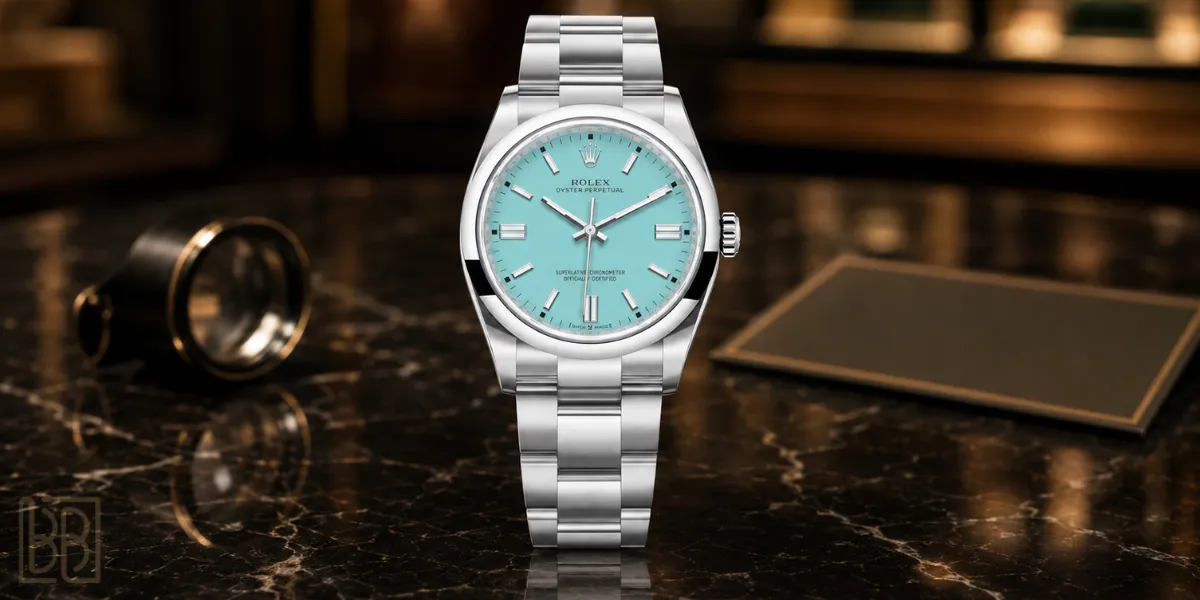
Five years ago, the Rolex Oyster Perpetual 41 Turquoise (ref. 124300) sat inside a collection people still called the "easy entry" into Rolex. The whole collection felt approachable steel, no date, fair retail. Today, one dial from that family can feel like a completely different purchase.
That is the shock. A watch tied to a collection many buyers remember as accessible has become a serious market decision, especially when the example is a clean full set, lightly worn, with the right warranty card date.
The reference is the Oyster Perpetual 41, ref. 124300, with the turquoise dial. Some buyers call it "Tiffany blue," although Rolex never needed the nickname to make it desirable. The market did that on its own.
The Watch People Wish They Bought Earlier
In boutique conversations, this is one of those watches that brings out the same sentence again and again: "I should have bought it when it was cheaper."
Here is the honest nuance, though. The turquoise was never truly cheap. It was hyped almost from launch; by 2021, waitlists for the turquoise dial were already stretching past two years. What changed is the frame around it. People remember the Oyster Perpetual as the simple, sensible Rolex, then look at turquoise prices today and feel a gap that never quite existed for this exact dial.
That gap is real for the line, less so for turquoise specifically. A serious buyer should know the difference before paying.
From ~$6K Retail to a Discontinued Premium
Indicative price trajectory of a clean full set. The market peaked in 2022, cooled, then settled well above retail.
Figures are indicative and based on observed secondary-market positioning for clean full-set examples, not guaranteed transaction prices. Asking prices can vary sharply by year, condition, card date, polishing history, and seller location.
Indicative trajectory for a clean full set, USD secondary market. Anchored on launch retail, the 2022 reference peak, and current turquoise market positioning. Figures move with the market — verify current prices before buying or selling.
Why the 134300 Launch Made This Sharper
In 2025, Rolex watches introduced the ref. 134300, replacing the 124300 as the 41 mm Oyster Perpetual. The new generation brought slimmer lugs, a larger crown, a refined clasp, and an entirely new dial language soft matte pastels like pistachio, beige, and lavender.
The bold glossy dials of the old generation turquoise, coral red, yellow did not move forward. They were left behind in the 124300. That is the moment turquoise stopped being "a current Rolex you might find" and became "a discontinued reference the market has to source."
Discontinuation did not happen quietly years ago. It became concrete with the 2025 generation change. For a dial whose entire value rests on identity and scarcity, that catalogue line matters more than any single price.

The Price Story Is Not a Straight Line Up
The 124300 did not simply climb forever. Across the reference, the market peaked around $22,000 in April 2022, then cooled significantly, with standard dials drifting back toward roughly $8,000 by early 2025 still above a retail price of about $7,000, but far from the peak.
Turquoise is the exception that proves the point. While ordinary dials gave back most of the hype, the discontinued bright dials held a heavy premium, often trading anywhere from the high teens to the low thirties depending on year, set, and condition.
So the real lesson is not "this Rolex only goes up." It is that the market separates a configuration from a collection. A black or silver 124300 follows ordinary Oyster Perpetual logic. A clean turquoise follows collector logic. Same case, same movement, very different conversation.
Which Rolex OP 41 Dial Commands the Premium?
A visual comparison of Rolex Oyster Perpetual 41 dial colours on the pre-owned market based on relative collector demand, not a fixed selling quote.
| Dial | Market status | Collector demand | Indicative premium |
|---|---|---|---|
| Turquoise “Tiffany” | Discontinued glossy dial | Very high | Heavy premium |
| Coral Red | Discontinued glossy dial | Very high | Heavy premium |
| Sun Yellow | Discontinued glossy dial | High | Strong premium |
| Green | Continued-style colour family | Moderate | Modest premium |
| Silver | Classic configuration | Steady | At / near retail logic |
| Black | Classic configuration | Steady | At / near retail logic |
The bold glossy dials — especially turquoise, coral red and yellow — are the versions the market repriced most aggressively after they left the catalogue. Standard colours still behave closer to ordinary Oyster Perpetual market logic. Indicative only; confirm current figures before buying or selling.
Why Dubai Buyers Feel This One?
Dubai clients are especially sensitive to this kind of movement, because the city runs a very active luxury resale culture. Buyers here compare constantly. They ask about global asking prices, local availability, card date, box and papers, polishing, and resale ease. They do not only ask, "Is this Rolex beautiful?" They ask, "Is this a strong example?"
That is why the old price feels impossible now. Many buyers remember when turquoise looked like a straightforward steel Rolex purchase. In 2026, a clean turquoise 41 mm is judged as a collectible dial configuration and priced like one.

Condition Changes Everything Here
A full set matters. Original box, warranty card, manuals, and correct accessories build resale confidence. A watch-only example can still sell, but it usually needs a more careful price discussion. The warranty card date matters too. Earlier examples can feel closer to the original launch story, while later pieces are judged on availability and condition.
Polishing is the quiet value killer. Many buyers look only at the dial first, but a serious buyer checks the case. Softened lugs, rounded edges, or an over-polished bracelet reduce confidence even when the watch still photographs well. And on a watch where the dial is the value, any concern around dial originality, replacement, or service history rewrites the price logic instantly.

Is the Turquoise 124300 Still Worth Buying in 2026?
If the watch is a clean full set, unpolished or very lightly polished, with strong documentation and a realistic asking price, the turquoise 124300 can still make sense for a buyer who understands why it trades at a premium.
It is not the cheapest path into Rolex. It is not the safest choice for someone who just wants a daily steel watch and never thinks about resale; a black dial Oyster Perpetual, a Datejust, or a Rolex Submariner is more rational there , a Datejust, or a rolex Submariner is more rational there.
But for a buyer who wants a discontinued Rolex with instant visual identity, deep collector recognition, and a clear price story, the turquoise 41 mm remains one of the most interesting modern references.

The Real Takeaway
The story of the turquoise Oyster Perpetual 41 is not just a colorful dial getting expensive.
It is a lesson in how fast the modern Rolex market can reprice a watch when supply, collector attention, and a generation change land at the same time. Five years ago, this felt like a fun steel Rolex. After the 134300 arrived in 2025, it became a discontinued reference that forces a sharper question: are you buying it because you love it, because you missed the old price, or because you believe the market still supports it?
ALSO READ: 5 Mistakes First-Time Luxury Watch Buyers Make in Dubai
The best buyers know the difference and that is exactly the conversation worth having before you spend.
Rolex Oyster Perpetual 41 Turquoise FAQs
Is the Rolex Oyster Perpetual 41 Turquoise discontinued?
Yes. The turquoise dial was part of the ref. 124300, which Rolex replaced in 2025 with the ref. 134300. The new generation moved to matte pastel dials, leaving the glossy turquoise as a discontinued configuration now only available on the pre-owned market.
Why is the turquoise Rolex called "Tiffany"?
Buyers nicknamed it "Tiffany blue" because the dial color resembles the famous robin's-egg shade. Rolex never used the name officially — the market adopted it on its own.
How much does a Rolex Oyster Perpetual 41 Turquoise cost in 2026?
Prices vary widely by year, condition, and set. While standard 124300 dials trade close to ordinary Oyster Perpetual levels, clean turquoise examples command a significant premium as a discontinued collectible dial. Always price against current verified market data.
Is the turquoise Oyster Perpetual a good investment?
It can hold value well thanks to its discontinued status and strong recognition, but no watch is guaranteed to appreciate. The safest approach is to buy a clean full set at a realistic price and enjoy the watch regardless of market movement.
What's the difference between the 124300 and the new 134300?
The 124300, introduced in 2020, offered bold glossy dials like turquoise, coral red and yellow. The 134300, introduced in 2025, brought matte pastel dials, slimmer lugs, a larger crown and a refined clasp, while keeping the same Caliber 3230 movement.

We are the Behzadi Boutique Team, a group of luxury watch specialists and dedicated writers focused on the world of fine timepieces. At Behzadi Boutique, we create clear, practical, and market-aware watch content to help collectors, buyers, and sellers make more confident decisions in the luxury watch market.

I’ve seen a big price gap between different Rolex Oyster Perpetual 41 Turquoise listings in Dubai. Is the difference mostly because of the condition and full set or is the dial demand itself the main reason?
Great question. With the Oyster Perpetual 41 Turquoise, the dial demand is a major reason behind the premium, but condition, full set, year, polishing history, and overall originality can also make a noticeable difference. Two watches may look similar online, but once inspected closely, their market value can be quite different.