Luxury Watch Blog & Guides
How to Spot a Fake Audemars Piguet Watch?
If you’ve spent time around a genuine Audemars Piguet, you stop relying on obvious signs. The logo alone doesn’t tell you much. What matters is how the watch is put together, how each component behaves under closer inspection. Most counterfeits aren’t immediately terrible. The problem is that they don’t stay convincing once you slow down and look properly.
Case Finishing And Surface Transitions
Start with the case. Not the shape, not the size, look at the finishing. Audemars Piguet is known for extremely controlled transitions between brushed and polished surfaces. The brushing isn’t random; it runs in a uniform direction, with a grain that stays consistent across the entire surface. Then you have the bevels, which are sharply cut and mirror-polished.
These edges catch light in a very specific way. On a replica, this is usually where things begin to fall apart. The brushing might look slightly uneven, almost washed out in certain angles. The polished edges tend to lose their definition, appearing rounded instead of precise. It’s not something you always notice in photos, but on the wrist, it becomes obvious.
Case Finishing And Surface Transitions
The difference shows where brushed surfaces meet polished bevels. Clean lines vs soft transitions.
Brushing stays consistent. Edges are sharp. Light breaks cleanly across surfaces.
Grain feels uneven. Edges lose definition. Transitions look soft and unclear.
How To Spot A Fake AP Fast?
Use these checks before you trust the watch, the seller, or the paperwork.
Check The Case Finishing
Look for sharp brushed surfaces, clean polished bevels, and controlled transitions between both finishes.
Inspect The Dial Texture
The Tapisserie pattern should have depth, clean geometry, and consistent spacing under light.
Study The Movement
Real AP movements show proper architecture, beveling, Geneva stripes, polished screws, and refined finishing.
Review The Price
If the offer sits far below the market range, treat it as a serious warning sign before buying.
Dial Structure And Tapisserie Execution
The dial gives you more information than branding ever will. On models with a Tapisserie dial, each square is individually machined. There’s depth to it. When light moves across the surface, the pattern responds with subtle variation, not a flat reflection.
Fakes often try to replicate this visually, but they miss the construction. The pattern looks stamped rather than cut. The spacing may feel slightly off, even if you can’t immediately explain why. Over time, your eye catches that inconsistency.
Applied indices are another checkpoint. They should sit perfectly aligned, with no visible imperfections around their base. Even a slight tilt or uneven height is a sign that the dial hasn’t been assembled to the same standard.
Dial Structure And Tapisserie Execution
The dial often reveals more than the logo. A genuine Tapisserie dial has visible depth, clean square geometry, and a surface that reacts subtly when light moves across it.
Machined depth, sharp square pattern, aligned indices.
Flat texture, stamped look, uneven spacing or tilted markers.
Movement Architecture And Finishing
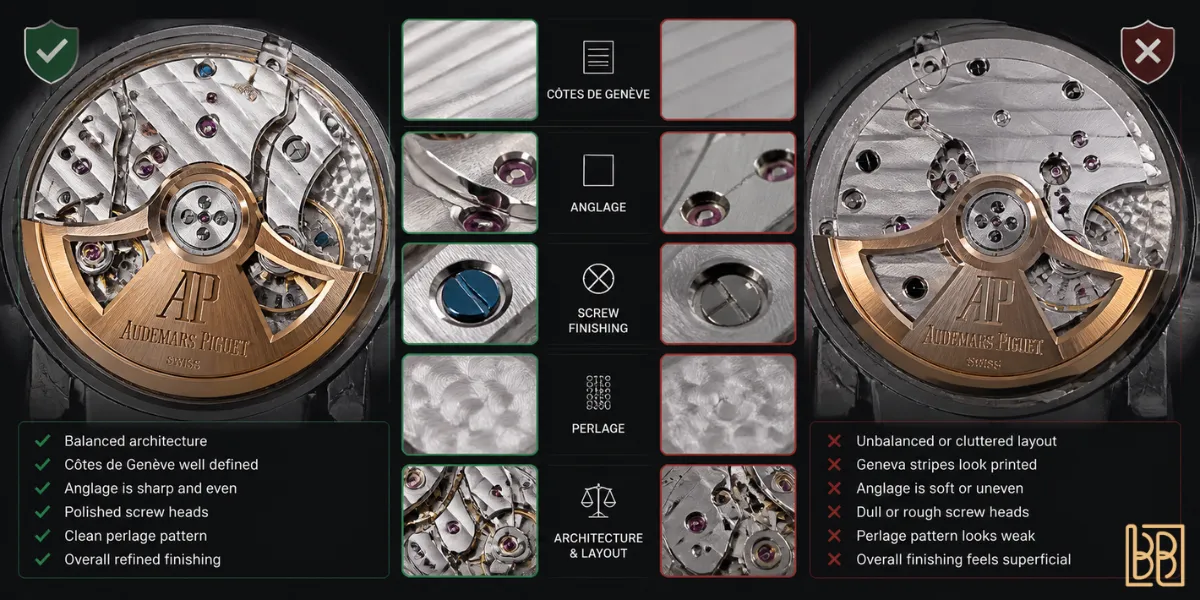
This is where the gap becomes technical. Audemars Piguet movements are designed in-house, and that shows in the layout. There’s a sense of balance in how the bridges are arranged.
Finishing techniques like côtes de Genève, perlage, and anglage aren’t decorative extras, they’re executed with precision, often by hand.
When you look at a counterfeit movement, it might try to imitate these finishes, but the execution feels superficial. The Geneva stripes may look too uniform, almost printed rather than cut. Edges lack proper beveling.
Screws don’t have the same polished heads. More importantly, the architecture itself can feel off. Even if the watch runs, the movement doesn’t have the same visual logic or refinement.
Weight Distribution And Material Behavior
You don’t need exact measurements to notice material differences. You just need a bit of attention. A genuine Audemars Piguet has a certain balance. Whether it’s steel, gold, or titanium, the watch feels solid without being awkward. The weight is distributed evenly across the case and bracelet.
With replicas, that balance often shifts. Sometimes the watch feels too light because of lower-grade alloys. Other times it feels heavy, but not in a controlled way. The bracelet might not articulate smoothly, creating a slight resistance when it moves on the wrist.
Weight Distribution And Material Behavior
Balance shows itself in motion. Not numbers. Not specs.
- Even weight across case and bracelet
- Stable feel on wrist, no shifting
- Material density feels controlled
- Weight feels too light or inconsistent
- Bracelet movement lacks fluidity
- Balance shifts during wrist movement
Bezel Screws And Alignment Precision
On models like the Royal Oak, the bezel screws are a detail that can’t be ignored. These screws are not randomly positioned. Each one sits in a fixed orientation, aligned consistently across the bezel. The geometry of the screw heads is clean and sharply defined.
In counterfeit versions, alignment tends to drift. Some screws may sit at slightly different angles. Others may appear deeper or less defined. It’s a small detail, but it reflects the level of precision behind the entire watch.
The same logic applies to engravings. Caseback text should appear clean, deep, and evenly spaced, with typography that matches the brand’s standards. When those elements feel inconsistent, it usually points to a broader issue in manufacturing quality.
Bezel Screws And Alignment Precision
AP details are strict. The bezel screws, octagonal geometry, and caseback engraving should all feel intentional.
Octagonal Bezel Logic
The Royal Oak bezel should keep its eight-sided geometry sharp, balanced, and visually even.
Aligned Hex Screws
AP bezel screws should not look randomly placed. Direction, depth, and spacing must feel controlled.
Caseback Engraving
Text should be deep, clean, evenly spaced, and matched to AP’s refined typography standards.
Bracelet Integration
On Royal Oak models, the bracelet should meet the case cleanly, without uneven gaps or loose geometry.
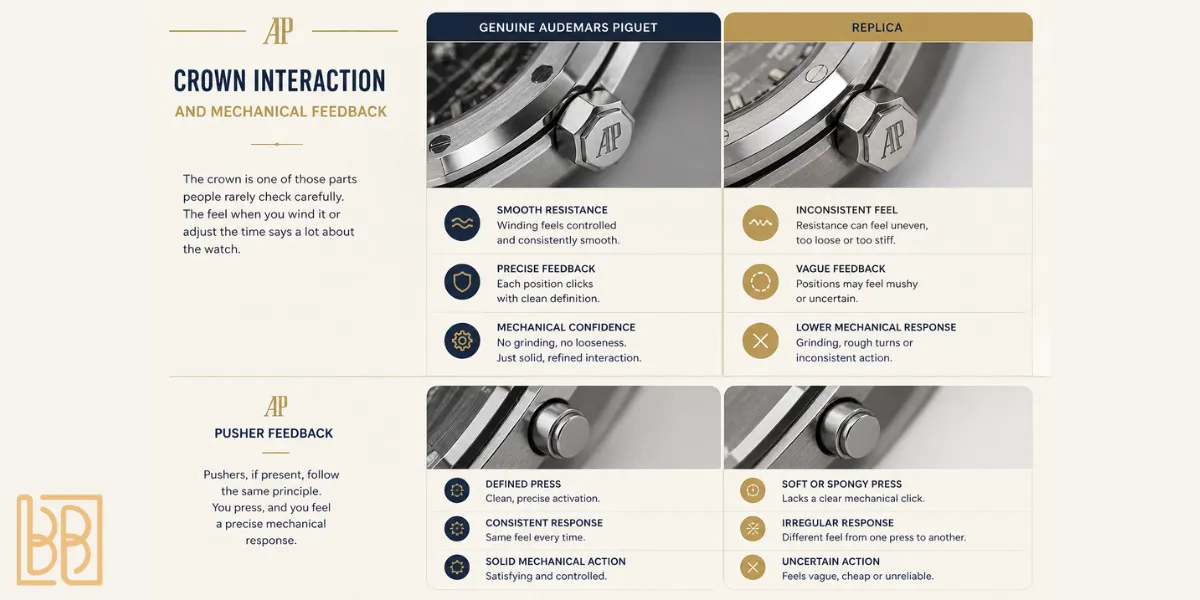
Crown Interaction And Mechanical Feedback
The crown is one of those parts people rarely check carefully. On a genuine piece, winding the crown feels controlled. There’s a smooth resistance, without any grinding or looseness. It’s subtle, but it’s consistent. Pushers, if present, follow the same principle. The feedback is defined.
You press, and you feel a precise mechanical response. Replicas often miss this entirely. The action can feel vague, overly stiff, or inconsistent from one press to another.
Serial Numbers And Traceability
Serial numbers are often misunderstood. Having one doesn’t prove authenticity. What matters is whether the number makes sense in context. It should follow the correct format, appear in the right location, and align with documentation.
More importantly, it should be traceable through proper channels. High-quality counterfeits sometimes include convincing paperwork, but small discrepancies usually appear when you start cross-checking details carefully.

Price Behavior And Market Logic
Audemars Piguet doesn’t fluctuate randomly in price. If a watch is offered significantly below its typical market range, especially for high-demand references, there’s usually a reason behind it. The market for these pieces is relatively structured. Outliers tend to signal risk, not opportunity.
Conclusion
No single flaw confirms a fake. It’s the combination that matters. A slightly soft case edge, a dial that feels flat, a movement that lacks depth, each on its own might raise a question. Together, they form a pattern.
People who work with these watches regularly don’t rely on a checklist. They recognize inconsistencies because they’ve seen how the real thing behaves, over and over again. That’s really the point. With Audemars Piguet, authenticity isn’t about one obvious sign. It’s about precision carried through every detail.
Frequently Asked Questions
Key answers about spotting a fake Audemars Piguet watch before buying.
How Can I Tell If An Audemars Piguet Watch Is Fake?
Start with the case finishing, dial texture, movement layout, bezel screw alignment, serial number format, and overall bracelet feel. A genuine Audemars Piguet shows sharp finishing and controlled details across every part.
Is The Tapisserie Dial Important For Authentication?
Yes. On many Royal Oak models, the Tapisserie dial is machined with depth and precision. Fake versions often look flatter, softer, or slightly uneven when viewed closely under light.
Can A Fake Audemars Piguet Have A Serial Number?
Yes. A serial number alone does not prove authenticity. The number must match the correct format, placement, engraving quality, documents, and traceable ownership history.
What Is The Biggest Red Flag When Buying An Audemars Piguet?
A price far below the normal market range is one of the strongest warning signs. High-demand Audemars Piguet models rarely appear at unusually low prices without a reason.
Should I Authenticate The Watch Before Buying?
Yes. For a watch in this price range, professional authentication is worth it. A specialist can inspect the movement, caseback, dial, bracelet, and paperwork properly.

We are the Behzadi Boutique Team, a group of luxury watch specialists and dedicated writers focused on the world of fine timepieces. At Behzadi Boutique, we create clear, practical, and market-aware watch content to help collectors, buyers, and sellers make more confident decisions in the luxury watch market.