
Luxury Watch Blog & Guides
Why Richard Mille Is So Exclusive
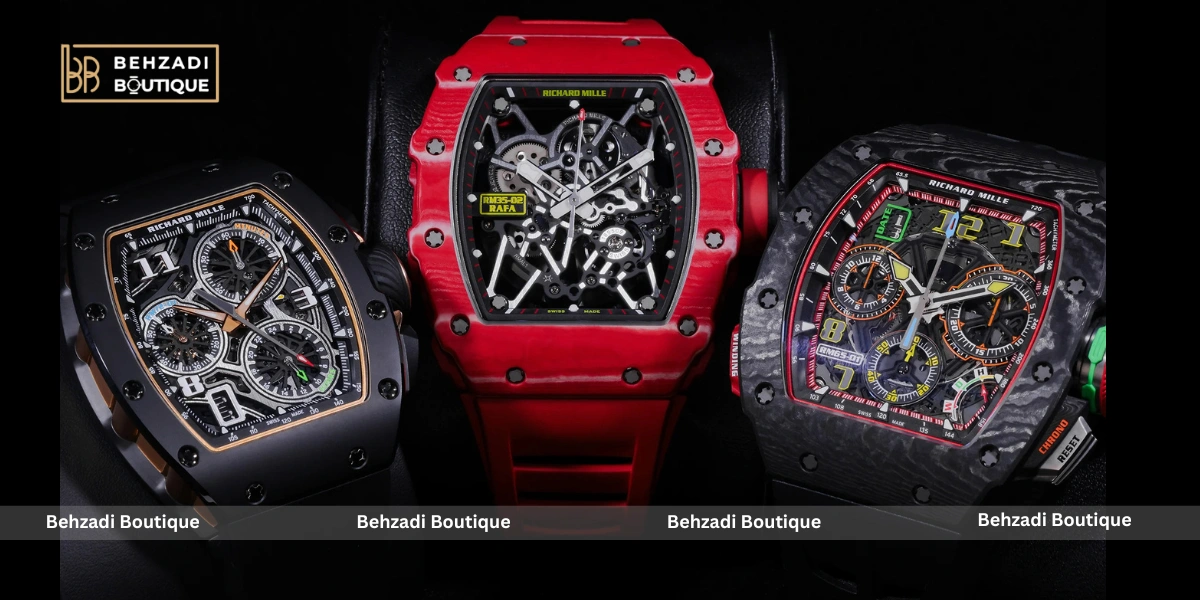
Richard Mille is not exclusive for just one reason. The brand sits in a rare position because it combines extremely limited production, unconventional engineering, advanced materials, and a buying process that is far more selective than most Swiss watch houses. In a market where many brands rely on history and heritage, Richard Mille built its identity around performance, innovation, and scarcity.
That combination is exactly why the brand feels so different. A Richard Mille watch is not only a luxury product or a status symbol. For many collectors, it represents a modern form of high-end watchmaking where technical ambition matters just as much as visual impact. The result is a brand that remains difficult to access, expensive to acquire, and highly visible in elite collector circles.
How Much is Richard Mille Watch?
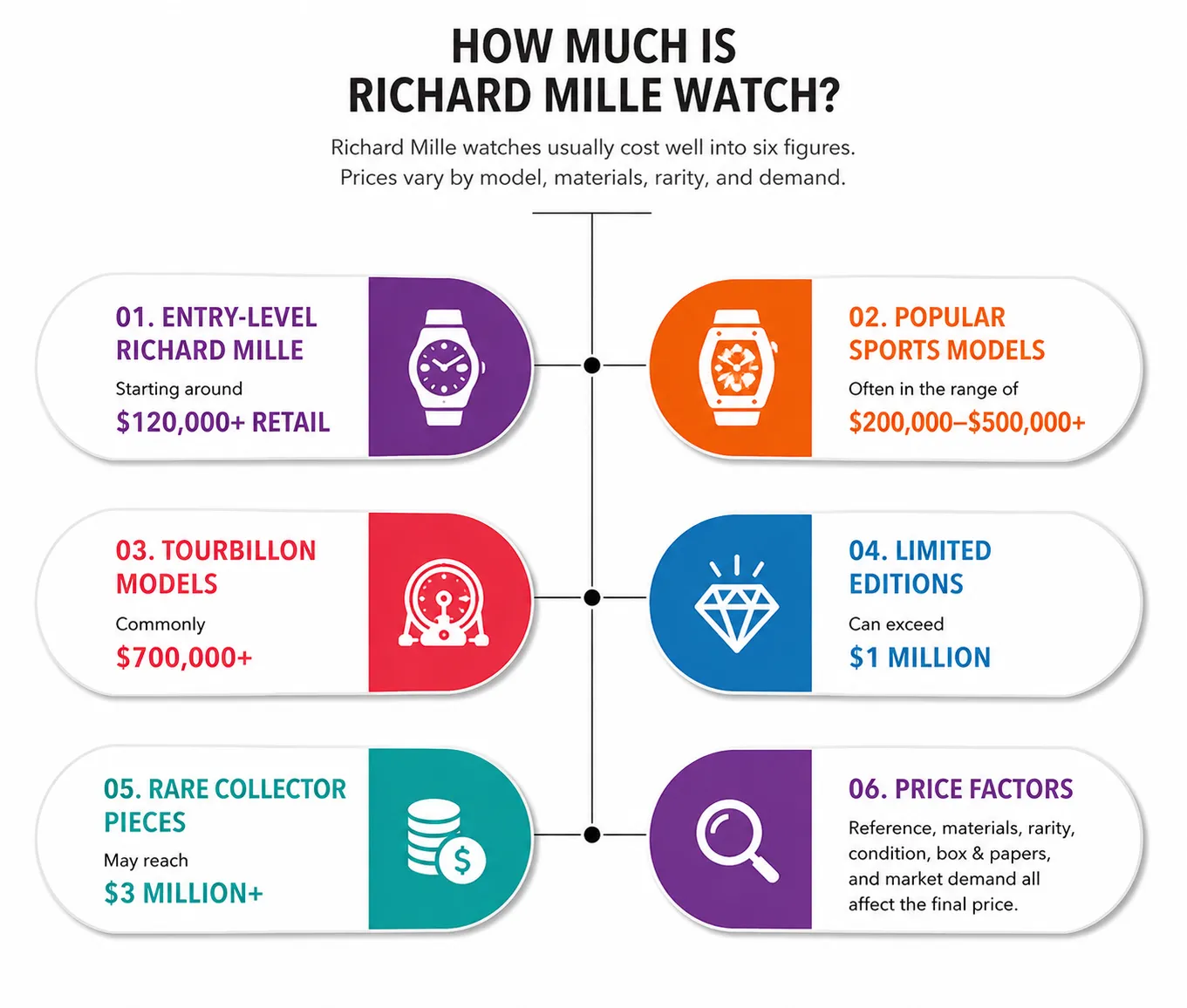
A Richard Mille watch usually costs well into six figures. Current 2026 price guides place many Richard Mille watches from about $120,000 at retail to $3 million+ for rare, complicated, or limited models, while secondary-market prices can move much higher depending on reference, condition, production numbers, and demand.
- Entry-level Richard Mille: around $120,000+ retail
- Popular sports models: often $200,000–$500,000+
- Tourbillon models: commonly $700,000+
- Limited editions: can exceed $1 million
- Rare collector pieces: may reach $3 million+
- Main price factors: reference, material, rarity, condition, box, papers, and market demand
- Important note: Richard Mille retail prices and market prices can be very different, especially for hard-to-buy models.
It Starts With Extremely Low Production
One of the clearest reasons behind Richard Mille exclusivity is production volume. The brand does not operate like a large-scale Swiss manufacturer producing tens of thousands of watches across many commercial lines. Instead, Richard Mille keeps output intentionally tight, which immediately places it in a different category.
That restricted production affects everything around the brand. Boutique allocation remains limited, waiting lists stay active for desirable models, and collectors often compete for the same references long before the watches become publicly visible.
A few important points explain why this matters so much:
- Annual production remains very limited compared to mainstream luxury brands
- Some references are made in extremely small numbers worldwide
- Boutique relationships often influence access to high-demand models
- Scarcity is built into the business model, not added afterward as marketing
This is one of the reasons Richard Mille feels exclusive in a very real sense. The watches are not only desirable. They are genuinely hard to get.
| Model Reference | Calibre | Power Reserve | Complications | Frequency (vph) | Approx. Retail (USD) |
|---|---|---|---|---|---|
| RM 11-03 | RMAC3 | 55 hours | Flyback Chronograph | 28,800 | ~$220,000 |
| RM 35-03 | RMAL2 | 55 hours | Sport Automatic | 28,800 | ~$180,000 |
| RM 27-04 | Manual Tourbillon | 70 hours | Tourbillon | 21,600 | ~$1,050,000 |
| RM 67-02 | CRMA7 | 50 hours | Ultra-thin Automatic | 28,800 | ~$300,000 |
The Materials Are Far From Ordinary
Richard Mille also stands out because of its material strategy. Traditional luxury watchmaking often centers on gold, platinum, steel, and sometimes titanium. Richard Mille moved beyond that and helped make high-tech composites part of modern watch culture.
Materials such as Carbon TPT and Quartz TPT are now strongly associated with the brand. They give the watches a distinctive texture and layered appearance, but the appeal is not only visual. These materials are chosen because they are light, strong, and technically difficult to produce.
That is a major part of the brand’s appeal. Richard Mille watches often look futuristic because they are built with a philosophy that comes closer to motorsport or aerospace than traditional dress-watch design.
Why these materials matter
- They reduce weight without sacrificing structural strength
- They create a unique visual identity from one watch to another
- They are difficult and costly to machine properly
- They reinforce the brand’s image as an engineering-first watchmaker
For collectors, this makes a Richard Mille feel less like a conventional luxury watch and more like an advanced mechanical object designed for high performance.
Why Richard Mille Stands in a Different League
Richard Mille exclusivity is not built on branding alone. The formula combines ultra-low production, advanced materials, highly technical movements, and a distribution model that keeps access extremely tight. This is why Richard Mille watches continue to attract serious collectors looking for rarity, engineering, and strong market presence in one package.
Low Annual Production
Richard Mille produces a very limited number of watches compared to major Swiss luxury brands, which keeps core references and limited editions consistently difficult to obtain.
Advanced Case Materials
Carbon TPT, Quartz TPT, titanium, and other technical materials give Richard Mille watches a distinctive look while reinforcing the brand’s engineering-first identity.
High Secondary Demand
Many Richard Mille models trade at strong premiums on the secondary market, especially rare sports references, athlete editions, and ultra-light performance models.
Selective Buying Process
Access often depends on boutique relationships, purchase history, and market availability, making ownership feel more exclusive than with conventional luxury watch brands.
Richard Mille is exclusive because every part of the brand supports scarcity — from production volume and material innovation to collector allocation and resale strength. It is a luxury watch brand built around modern engineering, not mass-market visibility.
Collector Note
For buyers comparing high-end independent watchmakers, Richard Mille offers a very different ownership experience. The appeal is not only in status or design. It is in the mix of technical experimentation, limited access, and the strong visibility the brand maintains across elite collector circles.
Frequently Asked Questions
Why are Richard Mille watches so expensive?
Pricing reflects limited production, complex case construction, advanced materials, technical movements, and extremely strong global demand from collectors.
Are Richard Mille watches hard to buy at retail?
Yes. Many popular references are difficult to secure through boutiques because supply is limited and allocation is often relationship-driven.
Do Richard Mille watches hold value?
Many of the most desirable Richard Mille models perform strongly on the secondary market, although premiums can vary depending on reference, rarity, condition, and market timing.
The Case Construction Is Part of the Exclusivity
The case is one of the most important parts of a Richard Mille watch. At first glance, the tonneau shape may seem like a recognizable design code, but in reality it is one of the brand’s most technically demanding features.
Producing these cases to the required tolerances is not simple. The curved structure, layered build, screw placement, and crystal integration all require significant precision. This is especially true when complex materials are involved.
That is why Richard Mille cases are not just visually bold. They are central to the watch’s identity. The case is part of the engineering concept, part of the comfort on the wrist, and part of the reason the watch costs what it does.

Richard Mille Pricing Reflects a Different Kind of Luxury
Richard Mille pricing often shocks people who are new to the brand, but the numbers make more sense when viewed through the brand’s full strategy. The watches are not positioned as entry-level luxury pieces. They are built for a niche segment of buyers who want rarity, technical innovation, and instant recognition in one product.
Retail prices already sit very high, and special editions or advanced complications can rise dramatically from there. Once demand exceeds boutique supply, the secondary market often pushes those numbers even higher.
In practical terms, buyers are paying for several things at once:
- very low production
- difficult manufacturing
- advanced materials
- strong collector demand
- highly controlled distribution
That combination is why Richard Mille holds such a unique place in the market. The brand is expensive, but it is also deliberately structured to remain outside the reach of ordinary luxury consumption.
What Truly Makes Richard Mille So Exclusive?
Richard Mille sits in a category where scarcity, engineering, advanced materials, and brand positioning work together at the highest level. It is not exclusivity built on image alone. It is exclusivity backed by low production, difficult construction, and a market that consistently rewards rarity.
Controlled Production
Richard Mille keeps production deliberately limited, which helps preserve scarcity across core references, sport models, and highly sought-after special editions.
Advanced Materials
Carbon TPT, Quartz TPT, titanium, and other technical materials strengthen the brand’s identity while making each piece feel more experimental and performance-driven.
Engineering-Led Design
The brand is known for complex tonneau cases, skeletonized movements, and an unmistakably technical visual language that separates it from more traditional Swiss watchmaking.
Selective Ownership
Access to desirable references is often shaped by relationships, purchase history, and limited allocation, which makes acquisition part of the exclusivity itself.
Exclusivity Is Built Into Every Layer of the Brand
Richard Mille is difficult to compare directly with conventional luxury watch brands because its exclusivity comes from several layers at once: technical innovation, low-volume production, selective retail access, distinctive material use, and powerful secondary market visibility.
For many buyers, the attraction is not only price or recognition. It is the feeling of wearing something highly engineered, hard to obtain, and instantly identifiable within elite watch circles.
- Extremely limited availability
- Distinctive case architecture
- Modern technical identity
- Strong collector prestige
Why is Richard Mille considered more exclusive than many Swiss brands?
Because the brand combines low output, difficult manufacturing, premium materials, selective distribution, and strong collector demand in a way very few watchmakers can replicate.
Is the buying process part of the brand’s appeal?
Yes. Boutique access, waiting time, and limited allocation all contribute to the perception that Richard Mille ownership is reserved for a smaller circle of collectors.
Do Richard Mille watches attract attention on the resale market?
Many references do, especially lightweight sport models, limited editions, and pieces with unusual case materials that remain difficult to source through retail channels.
Limited Editions Make the Brand Even More Desirable
Richard Mille has been especially effective in how it handles limited editions. The brand does not release special pieces simply to add variety. Most limited models feel connected to a larger performance story, athlete partnership, or technical objective.
This matters because it gives the watches more credibility. A collaboration tied to a professional athlete or racing environment feels consistent with the rest of the brand. It does not look random or forced.
Many of these editions are produced in very small numbers, which naturally increases collector interest. Once they are allocated, they often move quickly into private collections, where they become even harder to source.
The Movements Match the Exterior Philosophy
The inside of a Richard Mille watch is just as important as the exterior. The movements are designed to look technical, lightweight, and modern. Skeletonization is not used only for style. It helps define the architecture of the watch and supports the brand’s engineering language.
Many Richard Mille calibres use titanium components and highly technical layouts that emphasize rigidity and weight reduction. The result is a movement that feels purposeful rather than decorative.
This is one of the reasons collectors who appreciate modern mechanical design are so drawn to the brand. Richard Mille movements do not try to imitate old-school Swiss elegance. They present something sharper, more structural, and more contemporary.
Secondary Market Strength Reinforces the Exclusivity
The resale market adds another layer to Richard Mille’s status. When a brand consistently trades above retail, especially in the upper tiers of the watch world, that changes how collectors perceive it.
Richard Mille has benefited from exactly that dynamic. Many sought-after references, especially sport models and limited editions, command strong premiums on the secondary market. Buyers who do not want to wait for boutique allocation often turn to trusted dealers and private networks instead.
This creates a cycle that keeps the brand highly visible:
- low production limits supply
- limited supply increases demand
- high demand strengthens resale pricing
- strong resale pricing boosts prestige even further
That cycle is a major reason why Richard Mille continues to feel aspirational even among seasoned collectors.
Richard Mille Exclusivity Goes Beyond Price
The appeal of Richard Mille is not built on cost alone. What makes the brand exceptional is the way it blends low-volume production, highly recognizable design, advanced case construction, and a collector culture that values access almost as much as ownership.
A Brand Built Around Presence, Engineering, and Scarcity
Richard Mille occupies a unique position in the modern watch world because it does not try to compete through classical aesthetics alone. The watches project a visual identity that is immediate and unmistakable, while the engineering behind them reinforces the idea that these are highly specialized objects rather than standard luxury accessories.
That combination matters. Many collectors are not only drawn to the materials or the movement architecture, but to the overall ownership experience. A Richard Mille often signals access to a narrower segment of the market where allocation, rarity, and technical storytelling all carry real weight.
Recognizable Design Language
Few modern watch brands are as instantly identifiable. The shape, dial architecture, and case presence create an identity that stands apart even at a distance.
Exclusivity Through Access
For many references, demand is not the only challenge. Access itself becomes part of the appeal, especially when boutique allocation remains limited.
It Commands Attention Without Looking Traditional
Richard Mille watches do not follow the old formula of quiet luxury. They are bold, architectural, and unapologetically modern, which gives the brand a different kind of prestige in contemporary collector culture.
Scarcity Supports the Brand Image
The market sees Richard Mille as exclusive not just because pieces are expensive, but because obtaining one often requires timing, network access, and patience in addition to budget.
The Brand Feels More Like a Category Than a Collection
Within luxury sports watch culture, Richard Mille has built a lane of its own. Buyers are often choosing into a very specific world of modern horology rather than simply choosing another high-end watch.
“The exclusivity of Richard Mille comes from the fact that the watches are difficult to compare directly with anything else. They look different, feel different, and are acquired differently.”
Is Richard Mille exclusivity mainly about price?
No. Price is only one part of the story. Design identity, low availability, and restricted access all play an equally important role.
Why do collectors keep chasing the brand?
Because Richard Mille combines strong visual recognition with scarcity, technical appeal, and a powerful reputation within elite watch circles.
Buying Richard Mille Is Part of the Experience
Another reason Richard Mille feels so exclusive is that buying one is rarely simple. For the most desirable references, ownership often depends on relationships, purchase history, and access to the right network.
A first-time buyer usually cannot expect immediate access to the strongest boutique allocations. In many cases, the practical route is the secondary market, where availability improves but pricing becomes much higher.
That buying process adds to the mystique. The challenge of acquiring the watch becomes part of the appeal. For many collectors, that difficulty only strengthens the sense that Richard Mille belongs in a category of its own.
What Makes Richard Mille So Exclusive
In the end, Richard Mille exclusivity comes from several factors working together rather than one single feature. The brand limits production, uses complex materials, builds technically demanding cases, develops highly modern movements, and controls access through a selective retail model.
What truly separates Richard Mille is the way these elements reinforce each other. Scarcity supports demand. Innovation supports pricing. Visibility supports collectibility. And the overall result is a brand that feels both contemporary and rare at the same time.
For collectors who want more than a traditional luxury watch, Richard Mille offers something far more specific: a highly engineered, highly recognizable, and highly restricted piece of modern horology.
Read More: Buyer Guide For Buy Franck Muller Watches

We are the Behzadi Boutique Team, a group of luxury watch specialists and dedicated writers focused on the world of fine timepieces. At Behzadi Boutique, we create clear, practical, and market-aware watch content to help collectors, buyers, and sellers make more confident decisions in the luxury watch market.
