Luxury Watch Blog & Guides
Rolex Bracelet Types Explained: A Complete Guide to Every Style
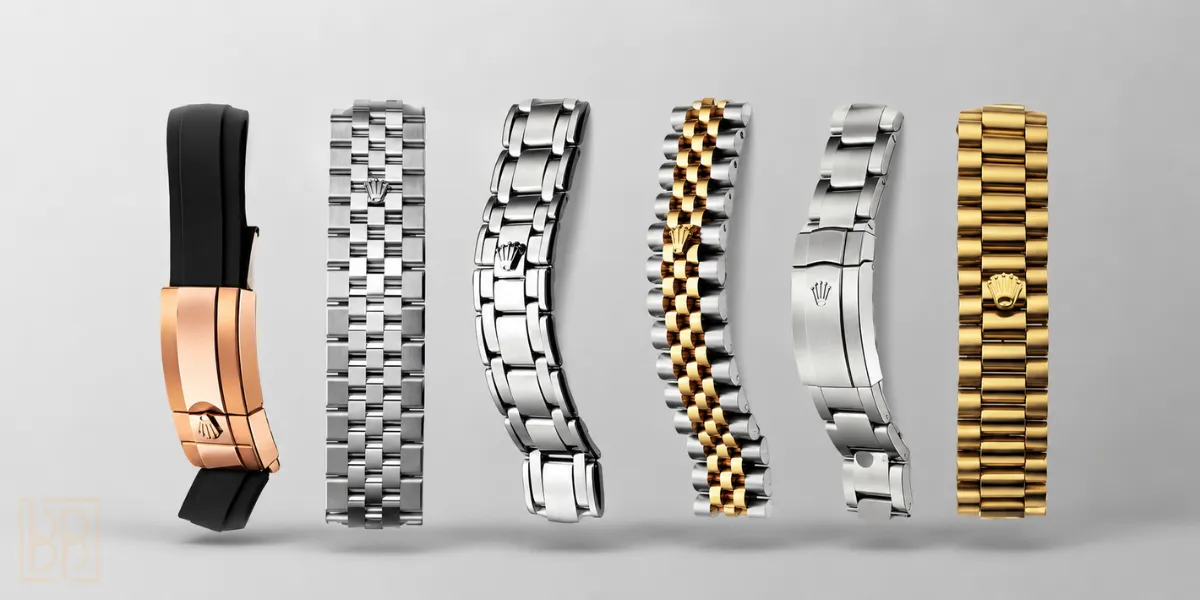
Rolex bracelet types differ in more than appearance. Link width, articulation, surface finishing, clasp construction and material all affect how a watch balances on the wrist, how easily it adjusts to temperature changes and how prominently it displays everyday wear.
This guide compares the Oyster, Jubilee, President, Oysterflex, Flat Jubilee, Settimo and historically important Pearlmaster bracelets. It explains their construction, associated Rolex models, practical strengths and limitations, while separating bracelet design from clasp systems such as Crownclasp, Oysterclasp and Oysterlock.
By the end, you should be able to recognise each major Rolex bracelet family and decide which design makes the most sense for your watch, wrist and intended use.
Rolex Bracelet Types at a Glance
The main Rolex bracelet families use noticeably different link structures. Oyster prioritises broad three-piece links, Jubilee uses five smaller articulated elements, President uses three rounded links, and Oysterflex combines an internal metal blade with an elastomer exterior. Flat Jubilee and Settimo, both introduced in 2025, are separate designs created for the Land-Dweller and 1908 respectively.
| Bracelet | Link Design | Typical Materials | Common Clasp | Associated Models | Overall Character | Status |
|---|---|---|---|---|---|---|
| Oyster | Three broad links | Oystersteel, Rolesor, 18 ct gold, 950 platinum and selected RLX titanium references | Oysterclasp or Oysterlock | Submariner, Daytona, GMT-Master II, Explorer, Datejust, Yacht-Master and others | Clean, substantial and sport-oriented | Current |
| Jubilee | Five-piece structure | Oystersteel, Rolesor and 18 ct gold, depending on reference | Oysterclasp, Oysterlock or Crownclasp | Datejust, Lady-Datejust, GMT-Master II and Sky-Dweller | Flexible, detailed and versatile | Current |
| President | Three semi-circular links | 18 ct gold or 950 platinum | Concealed Crownclasp | Day-Date and selected precious-metal Datejust references | Formal, rounded and substantial | Model Restricted |
| Oysterflex | Flexible metal blades covered in elastomer | Metal core and black high-performance elastomer | Oysterclasp or Oysterlock with Glidelock | Selected Yacht-Master, Daytona and Sky-Dweller references | Technical, sporty and warm-climate friendly | Reference Specific |
| Flat Jubilee | Five flat links with raised centre links | Oystersteel and white gold, Everose gold or 950 platinum | Concealed Crownclasp | Land-Dweller | Integrated, sharp and contemporary | Land-Dweller Only |
| Settimo | Seven small contoured elements | 18 ct yellow gold | Concealed Crownclasp | Perpetual 1908 | Fine, fluid and dress-oriented | 1908 Only |
| Pearlmaster | Five rounded links | Historically 18 ct gold, including gem-set versions | Concealed Crownclasp | Pearlmaster collection | Rounded and jewellery-oriented | Historical |
Model and clasp combinations can vary by reference, metal and production year. Rolex currently presents Oyster, Jubilee, President, Oysterflex, Flat Jubilee and Settimo in its bracelet documentation, while Pearlmaster information remains available through earlier official material.
What Are the Main Types of Rolex Bracelets?
The principal Rolex bracelet types covered by the current and recent catalogue are Oyster, Jubilee, President, Oysterflex, Flat Jubilee and Settimo. Pearlmaster remains historically important because it was created as a distinct rounded five-piece bracelet for the Pearlmaster collection in 1992, although that collection is not listed in Rolex’s current watch range.
These names describe bracelet architectures, not merely finishing patterns. A Jubilee remains a Jubilee whether fitted with a concealed Crownclasp or a visible Oysterclasp. Likewise, an Oyster bracelet may use a standard folding Oysterclasp, an Oysterlock safety clasp or a more specialised extension system depending on the watch.
Availability is therefore reference-specific. A bracelet shown on one Datejust, GMT-Master II or Yacht-Master should not be assumed to fit another generation of the same model
How Do Rolex Bracelet Types Differ?
Rolex bracelets differ through link geometry, the number of articulated components, surface treatment, material, attachment design and clasp system. These factors determine how closely the bracelet follows the wrist, how much visual attention it attracts, where weight is concentrated and whether the watch provides rapid adjustment for heat, activity or professional use.
The most useful comparison criteria are:
- Link structure: More individual elements generally create additional articulation points.
- Link shape: Broad, flat links read differently from rounded or jewellery-like profiles.
- Finishing: Polished surfaces reflect more light but usually reveal fine hairlines more readily than satin-finished surfaces.
- Weight: Full-gold and platinum bracelets create greater wrist presence than Oystersteel or elastomer-based designs.
- Clasp: Crownclasp prioritises visual continuity; Oysterlock adds a safety catch; Oysterclasp provides a conventional folding closure.
- Adjustment: Easylink provides approximately 5 mm of rapid extension, while Glidelock offers finer tool-free adjustment over a greater range on compatible references.
What Is the Rolex Oyster Bracelet?
The Rolex Oyster bracelet uses three broad links and is the brand’s most widely distributed metal bracelet architecture. Developed in the late 1930s, it has a visually direct construction that suits both professional watches and less overtly sporty models such as the Datejust Watches and Oyster Perpetual.
The broad centre and outer links create fewer visible joints than a Jubilee. This gives the Oyster a cleaner, more continuous surface and generally less lateral articulation. On professional models such as the Submariner or GMT-Master II, it is commonly paired with an Oysterlock safety clasp. Other watches may use an Oysterclasp, Crownclasp, Easylink or Glidelock depending on the reference.
Its practical strengths are structural simplicity, secure wrist presence and broad compatibility across the Rolex catalogue. Satin-finished versions also tend to disguise light cosmetic wear more effectively than bracelets with extensively polished centre links.
The trade-off is that the broader structure may feel less fluid than a Jubilee on narrow or sharply curved wrists. An Oyster bracelet with polished centre links can also show hairlines prominently, so the bracelet name alone does not determine scratch visibility.
What Is the Rolex Jubilee Bracelet?
The Rolex Jubilee bracelet uses a five-piece structure consisting of three narrower centre elements between two broader outer links. It was created for the introduction of the Datejust in 1945 and remains more articulated and visually intricate than the three-piece Oyster bracelet.
The additional joints allow the bracelet to follow the wrist through smaller increments. That physical articulation is the main reason the Jubilee is frequently regarded as comfortable, especially on wrists that do not form a broad, flat surface beneath the watch.
Traditional Jubilee finishing usually contrasts polished smaller centre elements with satin-finished outer links. This produces more reflected light than a fully brushed Oyster, but also creates more narrow surfaces and gaps that may require attentive cleaning.
Modern clasp arrangements depend on the watch. Some Datejust references use a concealed Crownclasp, while others use a folding Oysterclasp with Easylink. GMT-Master II Jubilee bracelets use an Oysterlock safety clasp, illustrating why a bracelet name should never be treated as the name of its clasp.
What Is the Rolex President Bracelet?
The Rolex President bracelet uses three semi-circular links and is made exclusively from 18 ct gold or 950 platinum. Rolex introduced it with the Rolex Day-Date in 1956, and its rounded geometry gives it a more formal and continuous appearance than the flatter Oyster bracelet.
The bracelet is normally paired with a concealed Crownclasp, allowing the links to appear visually uninterrupted around the wrist. Its curved links provide more articulation than their broad appearance might suggest, while the precious-metal construction creates significant weight and wrist presence.
Current and historical associations are more restricted than those of the Oyster or Jubilee. The President is principally linked with the Day-Date and selected precious-metal Datejust configurations. It should not be described as a bracelet available across the wider Professional collection.
What Is the Rolex Oysterflex Bracelet?
The Rolex Oysterflex bracelet is not simply a conventional rubber strap. Each side contains a flexible curved metal blade overmoulded with high-performance black elastomer, while cushioning on the underside helps stabilise the watch and limits the area resting directly against the skin. Rolex introduced Oysterflex on the Yacht-Master 37 in 2015.
Current Oysterflex applications include selected precious-metal Yacht-Master, Cosmograph Daytona and Sky-Dweller references. The bracelet is paired with a metal clasp matching the watch case, rather than a simple pin buckle. Current configurations also use Glidelock adjustment, although the clasp may be an Oysterclasp or Oysterlock depending on the model.
The elastomer exterior avoids the continuous metal-to-skin contact of a full bracelet, which can be useful in warm climates. The underside cushions also create ventilation channels and help control a heavier gold watch head.
Sizing requires attention because Oysterflex sections are supplied in different lengths. Glidelock provides useful fine adjustment, but it does not compensate for an incorrectly selected base size.
What Is the Rolex Flat Jubilee Bracelet?
The Flat Jubilee bracelet is a distinct five-piece integrated bracelet introduced with the Land-Dweller Watches in 2025. It retains the basic five-element arrangement of the traditional Jubilee but uses flat links, a raised polished centre section and a purpose-designed attachment that creates continuity between the bracelet and the Oyster case.
Three narrower polished centre links sit slightly above two broader outer links with technical satin finishing. The outer links have polished chamfered upper edges, extending a narrow line of reflected light from the case into the bracelet.
Unlike a conventional Jubilee, the Flat Jubilee is visually and mechanically integrated with the Land-Dweller. Rolex developed a concealed attachment system and fitted the bracelet with a hidden Crownclasp. Current Land-Dweller configurations include Oystersteel and white gold, 18 ct Everose gold and 950 platinum versions. It should therefore be treated as an independent bracelet design, not as a flattened cosmetic variation that can be fitted to an ordinary Datejust or GMT-Master II.
What Is the Rolex Pearlmaster Bracelet?
The Pearlmaster bracelet is a rounded five-piece solid-gold design created in 1992 for the launch of the Pearlmaster model. Official Rolex material describes it as being fitted with a concealed Crownclasp, while numerous historical configurations used precious-metal and gem-set surfaces to support the collection’s jewellery-led positioning.
READ ABOUT: How to Spot a Fake Rolex Watch
Although it also uses five elements, Pearlmaster should not be confused with Jubilee. Its links are fuller and more rounded, while the visual treatment is generally more jewellery-like. Compared with President, it uses five rounded pieces rather than three semi-circular links.
Pearlmaster does not appear among the collections on Rolex’s current official watch finder as of 18 July 2026. It should therefore be presented as a historically important bracelet and discontinued catalogue family unless Rolex reintroduces it. This status is an inference from the current official catalogue rather than an explicit Rolex discontinuation statement.
Which Rolex Bracelet Is the Most Comfortable?
There is no single most comfortable Rolex bracelet for every wearer. Jubilee and Settimo offer extensive articulation through numerous small elements, Oysterflex reduces continuous metal contact and includes underside cushioning, while a correctly sized Oyster can distribute the weight of a professional watch across a broad, stable surface.
For warm climates, Oysterflex has a practical advantage because its underside cushions create separation between much of the bracelet and the wrist. Glidelock also allows fine adjustment as the wrist expands.
READ MORE: Buy Best Rolex Watches in 2026
Jubilee is a strong choice for wrists that benefit from a bracelet conforming through many small articulation points. Settimo follows a similar principle but is restricted to a solid-gold 1908 configuration.
President and precious-metal Flat Jubilee bracelets can be highly articulated, but gold and especially platinum versions create greater overall weight. Comfort therefore depends as much on balance and sizing as on flexibility.
Which Rolex Models Use Each Bracelet?
Bracelet associations are controlled by the exact Rolex reference, material and production year. The following table identifies established current or historical relationships, but it should not be used as a universal compatibility chart.
| Bracelet | Common Current or Historical Rolex Models |
|---|---|
| Oyster | Oyster Perpetual, Datejust, Lady-Datejust, Air-King, Explorer, Explorer II, Submariner, Sea-Dweller, Deepsea, GMT-Master II, Cosmograph Daytona, Yacht-Master and Sky-Dweller. |
| Jubilee | Datejust, Lady-Datejust, GMT-Master II and selected Sky-Dweller references. |
| President | Day-Date and selected precious-metal Datejust configurations. |
| Oysterflex | Selected 18 ct gold Yacht-Master, Cosmograph Daytona and Sky-Dweller references. |
| Flat Jubilee | Land-Dweller. |
| Settimo | Perpetual 1908 in 18 ct yellow gold. |
| Pearlmaster | Historical Rolex Pearlmaster collection. |
The official Rolex catalogue confirms Oyster and Jubilee options on several model families, while the President, Oysterflex, Flat Jubilee and Settimo remain more tightly restricted.
Can Rolex Bracelets Be Swapped Between Models?
Rolex bracelets cannot be assumed to be interchangeable simply because two watches have the same nominal case diameter or bracelet style. Compatibility depends on the case reference, lug width, lug geometry, end-link shape, spring-bar position, bracelet reference and the way the first link articulates against the case.
Even watches within the same family can use different end links or bracelet references across generations. Integrated designs such as Flat Jubilee and Settimo are even more restrictive because their attachment systems were developed specifically for the Land-Dweller and 1908.
An incorrect bracelet may appear to fit between the lugs while leaving excessive movement, poor end-link alignment or unsuitable spring-bar engagement. This can damage the case or create a risk of separation.
ALSO READ: Rolex Nicknames Explained: Batman, Pepsi, Hulk & More
Before changing an original bracelet, obtain confirmation from an Official Rolex Retailer, Rolex Service Centre or a qualified watchmaker with access to the relevant bracelet and case-reference documentation. Rolex confirms that its official retailers and affiliates are authorised to receive watches for servicing.
How many types of Rolex bracelets are there?
A practical guide normally covers seven principal families: Oyster, Jubilee, President, Oysterflex, Flat Jubilee, Settimo and Pearlmaster. Additional vintage and reference-specific variations also exist.
Is the Oyster bracelet more durable than the Jubilee?
The Oyster bracelet uses three broad links and is commonly fitted to professional Rolex watches. A modern Jubilee is also robust, but its five-piece construction provides greater articulation. Material, clasp type, condition and intended use also affect durability.
Is Oysterflex made entirely from rubber?
No. Oysterflex contains flexible metal blades covered with high-performance black elastomer. Its underside cushions improve stability and reduce continuous contact between the bracelet and wrist.
Which Rolex bracelet is the most comfortable?
Jubilee is highly articulated, while Oysterflex can be practical in hot weather because of its cushioning and adjustment system. Comfort also depends on wrist shape, bracelet sizing, watch weight and clasp position.
What is the difference between Jubilee and Flat Jubilee?
Traditional Jubilee has a rounded five-piece structure. Flat Jubilee uses five flat links, raised polished centre elements and an integrated connection designed specifically for the Rolex Land-Dweller.
Is the President bracelet only available on the Day-Date?
The President bracelet was created for the Day-Date, but Rolex has also used it on selected precious-metal Datejust configurations. It is made exclusively from 18 ct gold or 950 platinum.
Can a Jubilee bracelet be fitted to any Rolex?
No. Compatibility depends on the watch reference, lug construction, end links, spring-bar placement, bracelet reference and case generation. Professional confirmation is recommended before installation.
Is the Pearlmaster bracelet still available?
Pearlmaster is not listed in the current Rolex catalogue. It remains relevant to collectors and buyers researching discontinued precious-metal and gem-set Rolex Pearlmaster watches.

We are the Behzadi Boutique Team, a group of luxury watch specialists and dedicated writers focused on the world of fine timepieces. At Behzadi Boutique, we create clear, practical, and market-aware watch content to help collectors, buyers, and sellers make more confident decisions in the luxury watch market.